
Cash vs. Insurance Billing: How to Choose the Best Model for Your Practice
Let’s face it: insurance vs cash billing isn’t the most fun topic. No matter where you’re located, it involves some admin. But for providers in the US, billing can also come with complex systems to understand, rules to abide by, and a laundry list of extra steps — and in the end, payment isn’t always guaranteed. Please don’t click away yet! :)
If “getting paid” is the destination, “billing” is the road that will take you there, and there are many routes to choose from.
The most straightforward is cash billing for healthcare providers — the good ol’ fashioned exchange of services for money that we’re all familiar with. Then, there’s insurance billing for small practices, where you’re making a few extra stops along the way, and navigating can get a little trickier. And, of course, there are options that fall somewhere in the middle, like hybrid models or courtesy billing.
It’s easy to get intimidated by such a complex topic when you don’t know where to start. But when choosing between insurance billing and cash-based practice models, knowing what works best for you and your practice is a great first step.
To help provide a sense of direction, we’ve brought in a couple of experts to share their insights.

So, what’s the difference between cash and insurance billing?
You could spend years learning about the differences between cash-based and insurance-based billing models alone — and luckily, some people do.
John Whaley works with Jane’s product development team and holds the unofficial record for the most time spent thinking about US medical billing (as a Canadian). His team focuses on making insurance billing for small practices as simple as possible, and with over five years of domain experience, he’s spoken to hundreds of practices, from cash-based to insurance-based and lots in between.
From John’s perspective, there are a few key factors that differentiate cash and insurance billing.
The first big difference lies in the practice’s cash flow — in other words, how long it takes them to get paid. For cash-based practices, payment is direct. For insurance billing it involves a lengthy revenue cycle. Starting before the patient even walks through the door and continuing on well past their visit, there are multiple steps in communicating with a patient’s insurer, with each acting as a stop sign on the road to getting paid.
“It can take a week, two weeks, even months to get paid by insurance,” John reminds me. “That whole time, your money is outstanding.” Cash practices don’t have these revenue cycle steps to consider. Your patient pays you in full right after their visit, and, barring any forgotten wallets, the cycle ends there.
Another factor that differentiates cash pay vs insurance billing models is how they attract new patients and clients. “Some insurers will advertise which providers are in-network in their area,” says John. Patients might seek out those providers specifically to save money — a marketing tool that cash practices don’t have access to.
While you might attract more patients through insurance, that benefit comes with a caveat.
“When you join an insurance network, you’re agreeing to their contracted rates,” says John. In other words, you’re accepting a cap on reimbursement — a common challenge with insurance billing for wellness practitioners compared to the freedom of direct pay healthcare models.
Which model is right for your practice?
This is a question that Dr. Noel Snodgrass has to continually ask himself.
Noel is a chiropractor and owner of Portland Chiropractic. He’s a seasoned practitioner at this point, but even after 17 years in practice, he continually reassesses his billing model. When it comes to reimbursement, Noel’s practice is a bit of a mixed bag. While primarily billing insurance, he’s starting to re-evaluate what his time is worth and whether a cash-based practice model or direct pay healthcare approach fits his business better — but he didn’t always have the luxury of this flexibility.
“In the beginning, you don’t want to starve to death, so you’ll take whatever people will pay you,” Noel mentions earnestly, admitting that he’s even accepted fresh salmon and bike parts as a form of payment in the early days of starting his practice.
Dr. Nick Meier experienced a very similar challenge as a new practitioner entering the cash vs insurance billing decision. Nick opened his clinic, Meier Family Chiropractic, knowing he had to get creative about building his patient base. “I originally planned on joining another office, but instead opened my own. I literally had enough money in savings to survive three months before I was needing to borrow money,” Nick shares. “Fortunately, in my third month I broke even, and it was all uphill from there.”
Both Noel and Nick’s practices progressed through different growth stages, each bringing new challenges and priorities. It’s these different “phases,” as Noel refers to them, that can help you decide what billing model is best for you. In the first phase, practitioners are typically asking themselves, “How do I get people in the door?” At this point, you’ll be starting to make a name for yourself and trying to attract as many patients as possible. This is why many new practitioners opt to join insurance provider networks, since being listed as in-network can drive patient referrals. That’s exactly what Nick did. He started joining the networks of local insurers one at a time, and credits this “slow and steady” approach for getting him over that third month hump, while avoiding overwhelm as a new practitioner.
Once you start to build your caseload, you move into a second phase, where, according to Noel, you can start to be a little more picky. This is a great point to stop and ask yourself, “What’s important to me right now?” For some, that might be simplicity, in which case you can consider dropping insurers to help lighten the workload. For others, this could be a time for growth — and if taking on more insurers feels feasible, you can consider hiring another set of hands to work through the extra billing tasks.
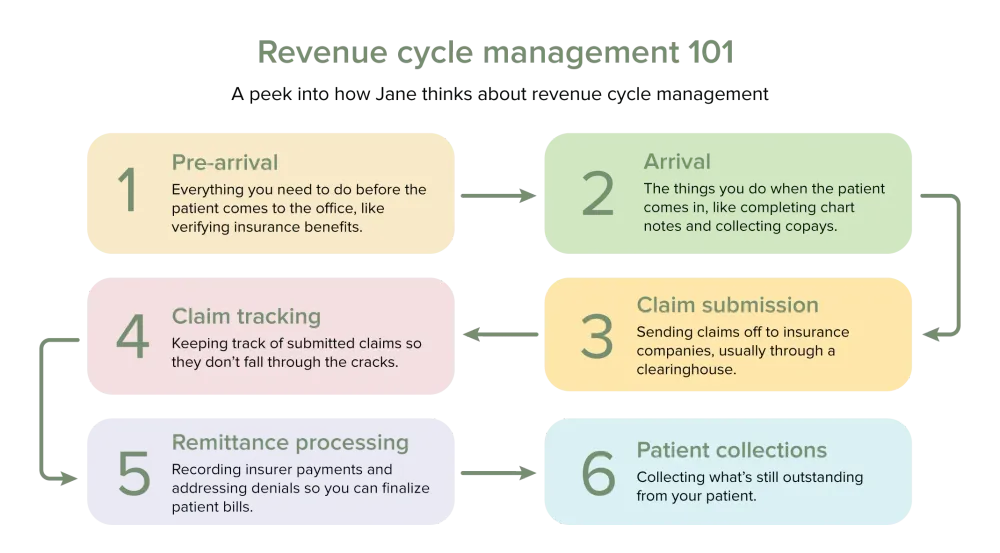
In the third phase, your main focus is refining. Noel suggests analyzing your income yearly. Look at the income generated by both insurance billing and cash billing. Whatever method is generating the least amount of money, consider dropping it. Noel admits that this step can be particularly scary, especially when considering how many of your patients will agree to pay your cash rate.
Noel describes the fourth and final phase as one where practices are steady, established, and comfortable with their daily tasks. At this point, many cash-based practitioners and wellness clinics ask, “What is my time worth?” and may transition away from insurance reimbursement challenges in favor of simpler private pay healthcare models. In asking himself that same question, Noel was quick to recognize that the time spent billing insurance could be directed towards things that sparked more joy, like creating marketing material or giving his patients a quick call to check in on their progress.

What to consider before choosing a cash or insurance billing model
When it comes to billing, there’s no one-size-fits-all solution — what might be a factor for one practice could be an afterthought for others.
Take location, for example. Noel’s practice is nestled amongst office buildings and schools right in the heart of downtown Portland. When he first opened, he started asking himself, “What patients am I attracting?” All he had to do was look around: patients were coming in on their lunch breaks and office hours, meaning they likely had coverage through their employers. The decision to use insurance billing for chiropractic services was based on what he was seeing from his patient demographic in the location where he set up shop.
Nick’s thought process looked slightly different. He started with what he knew. “Honestly, most of my colleagues accept insurance, and I know growing up seeing my own chiropractor, I typically used insurance,” Nick shares. He then looked at the logistics — researching the allowed amounts that different insurers offered, seeing how many people in his area used those insurers, and then deciding what rates were acceptable to him. Since being a cash-only chiropractic practice never really seemed to fit for him, Nick did his research and used that “slow and steady” approach to build his patient base with insurance billing models.
Nick and Noel looked at different factors when deciding on their billing models, and it’s important to recognize that those factors can change over time. Just as Noel has started to question the time he’s spending on insurance reimbursement challenges, don’t be afraid to re-evaluate your cash billing vs insurance billing model to make sure it’s still the right choice for your wellness practice or clinic.
The patient perspective on cash vs insurance billing
Despite all the moving pieces in these billing conversations, one thing remains constant — patients will always be involved. When it comes to cash pay healthcare models, patients can look at the price you list on your website and know exactly what they’re expected to pay. No surprises. With insurance billing, you add a handful of parameters that can muddle the cost, like allowed amounts and patient copays. So, while you might strive to be transparent about pricing with your patients, involving insurance often introduces elements beyond your control — some of which can be difficult to understand, and even more difficult to explain to your patient.
“Insurance can be really complicated for clinics, but it’s even more so for patients,” John explains. “A lot of patients don’t really understand their own benefits.” This is why some cash practices opt for courtesy billing in healthcare — the aptly-named process of submitting patients’ insurance claims on their behalf. Courtesy billing bridges the gap between cash pay clinics and patients who still want to leverage their insurance coverage. While it still requires the knowledge and resources needed to submit claims, courtesy billing allows patients to use their insurance coverage without tackling the intricacies of communicating with insurers themselves.
Not sure what courtesy billing looks like in practice? This courtesy billing guide breaks down the workflow step by step.
Regardless of whether you choose cash billing vs insurance billing, one thing Nick recommends is to “figure out the best charting practices first and foremost.” There’s a misconception that you don’t have to worry about documentation with cash billing. But odds are, your cash patients will still submit to their insurers, so providing them with accurate documentation will increase their chances of getting paid (and increase their chances of coming back to you)!
The learning process: gaining confidence in your billing approach
One of the hardest parts of navigating a big decision is that often, you don’t know what you don’t know. Since Nick started navigating the world of insurance, tasks that once seemed daunting are now commonplace. He’s learned the best way to get insurance benefit details without wasting too much time on hold. He’s learned the ins-and-outs of Insurance Claims & The CMS1500 — a foundation for electronic submissions that most practices eventually get comfortable with. Plus, he has become more confident with tasks like disputing denied claims and submitting provider inquiries.
⭐️ Pro tip: do not resubmit a claim if you need it adjusted — that will just create a duplicate, which will then get denied!
He didn’t always have this knowledge, but with some patience, compassion, and willingness to learn, he now feels confident about insurance billing.
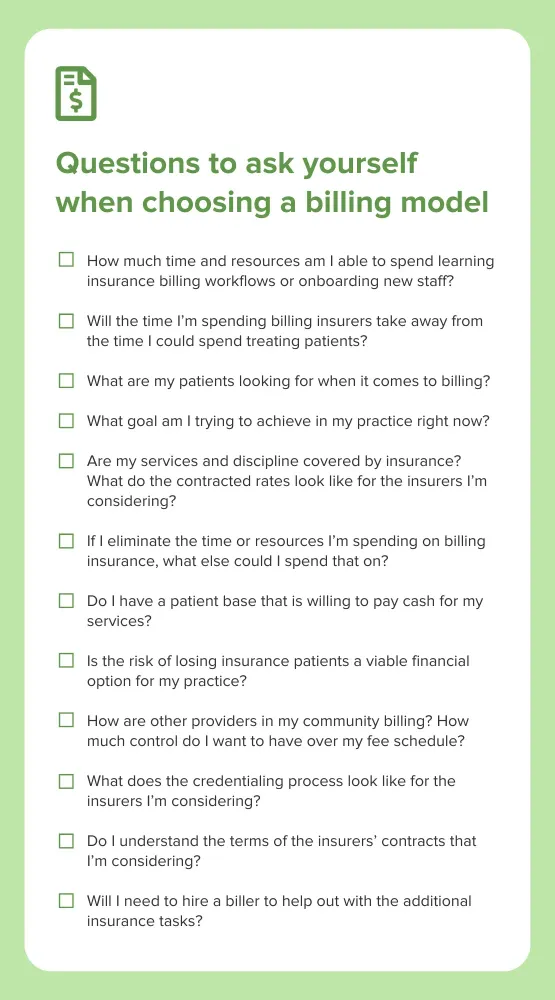
There’s so much you can learn from other practitioners, especially those who have faced the same cash vs insurance billing decision. So, we gathered some wisdom from the Jane community — here are some questions to ask when choosing a billing model for your wellness practice.
You might find the answers to these questions sparking up even more questions, and that’s okay! “I don’t think there’s one right answer,” John admits. But there is a best answer, and that depends on what works for you, your patients, and your practice.
Find Dr. Noel online at portlandchi.com and Dr. Nick at meierfamilychiropractic.com
📖 This article was originally published in volume 3 of Front Desk magazine and has been modified and updated.
