
How to Open a Clinic in Canada: Licenses, Registration, and What Practitioners Often Miss
Starting a private practice comes with a lot of firsts. Roxanne Francis, a business coach, psychotherapist, and CEO of Francis Psychotherapy, has seen firsthand what happens when practitioners are inspired and prepared, and what happens when one of those pieces is missing.
Getting your licenses, registration, and insurance in place before opening day isn't just a formality. This post walks through what you need to open a clinic in Canada, what gets missed, and how to set yourself up with confidence.
This article is for general information only and isn’t legal, tax, or professional advice. It’s always best to speak with a qualified expert about your specific situation before making financial or legal decisions.
Step 1: Register with your professional college
Opening a clinic in Canada means clearing a few non-negotiables before you see your first patient. No registration with your professional college, no business.
Roxanne says getting registered with your professional college should always be your first step. When you go to get insurance, one of the first things they’ll ask for is your registration number.
Once you've graduated, you can register online with your college. Approval is generally straightforward, though there are a few additional considerations.
Board or additional exams: Some disciplines require these before registration is complete. Factor that into your planning as it will add time between graduation and being ready to practice.
Association membership: Your professional college regulates your practice, but most practitioners also join a discipline-specific association. This is a separate step and a separate annual cost.
💡 Reminder: Most practitioners will need to renew their professional license annually, so make sure you budget for that ahead of time. It can run anywhere from roughly $200-$500. Association dues will also come up annually.
Step 2: Choose a business structure
When it comes to business structure, the two main options in Canada are sole proprietorship or incorporation. In Roxanne’s experience, it’s a great idea to speak with an accountant before making this decision, but if you can’t decide, she suggests starting as a sole proprietor and switching to a corporation down the line if needed.
Roxanne does note that incorporating changes the legal implications for practitioners should something go awry. “A benefit of incorporation is that it protects your assets. If something should go sideways and someone decides to sue you, if you are a sole proprietor then any personal assets you have are subject to legal action.”
However, if you incorporate, your business becomes a separate legal entity. So your car, or your condo, whatever you personally own, is protected.

Roxanne Francis is a business coach, psychotherapist, and CEO of Francis Psychotherapy
Step 3: Choose a business name and register it
Business registration in Canada is done at the provincial level unless you’re incorporating nationally. For example, if you’re starting a business in Ontario, you’d register through the Ontario Business Registry.
Before you register:
- Check if there are any naming rules and requirements enforced by your professional college. Some colleges will require first name, last name, professional designation.
- If you’re incorporating, make sure your business name is available. In most provinces, this is done through a NUANS search. It's mandatory for federal incorporation, and some provinces either use NUANS or have their own equivalent. A quick check now saves a headache later.
- Decide whether your registered name and brand name will be the same thing. They don’t have to be, but it does simplify things.
Roxanne started as a sole proprietor before incorporating, and when she incorporated, her business name had to change due to the requirements of her professional college. It wasn’t until she took a cheque to the bank one day, made out to her original business name, that she learned she wouldn’t be able to cash it.
“I went to the bank and they were like, where are you going with that?” The name on the cheque didn't match her registered business name. “And I said, well, I can't send it back to the company and ask them to get me a new one. That's just gonna be too much of a hassle.”
💡 Tip: Roxanne registered what’s called a Doing Business As (DBA) through the Ontario Business Registry, which cost only $60 and allowed her to cash her cheque.
When you’re ready to register:
- Complete the forms required by your province.
- Once processed, you’ll receive a BIN (Business Identification Number), which is your provincial identifier.
Step 4: Get your insurance
Now that you’re registered, it’s insurance time. “In order to practice, you need insurance,” says Roxanne. “You can’t start practicing without it.”
Most practitioners require professional liability insurance, which covers you in the event of a malpractice suit. Additionally, practitioners can add optional riders (extra coverage) depending on the type of practice you run.
Specific considerations:
- Do you have a physical space? If so, you’ll want to include tenants insurance if you’re renting your space, or property insurance if you own. Most insurance companies will offer these as add-ons. Be sure these policies also cover the equipment you use to run your practice.
- How many employees or additional practitioners will you be bringing on as full-time staff? The bigger your staff, the more insurance you will have to pay.
- Are you hiring any contractors? If, for example, you’re bringing on an independent associate, so someone who works within your practice but isn’t a direct employee, it’s key to be sure that person has their own liability insurance policy.
💡 Reminder: It’s good to check if your association has a relationship with an insurance company. Most do and can provide a discount on insurance. Insurance prices will vary for each practice type, but you can expect anywhere from $350-$700 per year for solo practitioners, while group plans may range from $700-$1500 annually.
Step 5: Get your finances in order
Once a practitioner has obtained their BIN, it’s time to go to the bank and open an account. “Once you have your business registered, you'll take that paperwork and then you'll go to the bank and open a business account right away,” says Roxanne. Separate accounts simplify taxes, protect liability boundaries, and keep your finances organized. “The last thing you want to do is, you know, muddle the situation between personal money and business money.”
Once you have a business account, it’s time to get a BN (Business Number) through the CRA.
Businesses earning more than $30,000 a year must register for federal and provincial sales taxes (GST/HST).
💡 Note: Some healthcare services are tax-exempt, but many practitioners operate mixed practices with both taxable and exempt services, so it can be valuable to set this system up either way.
For example, some of Roxanne’s clinical services are tax-exempt. But when she’s hired by organizations for speaking engagements, taxes apply.
Roxanne recommends finding an accountant you trust and understands your business, “I needed to find someone who knew about my line of work,” she says. “And so they were able to give me some solid advice around how to navigate the CRA, how to make sure that you're saving for taxes.”
An accountant will also help you parse through what is or isn’t a business expense. Roxanne sees practitioners make this mistake often. “You can write off a part of your living expenses if you work from home, and if you go from place to place to offer support to different people,” she says. “You can write off a part of your mileage if you track that.”
An accountant will help set up good systems. If you’re looking for an accountant but haven’t found one yet, keep saving those “write-off” receipts.
💡 Reminder: If you’re registered in Quebec, you’ll need to register with Revenu Québec for provincial deductions in addition to the CRA.
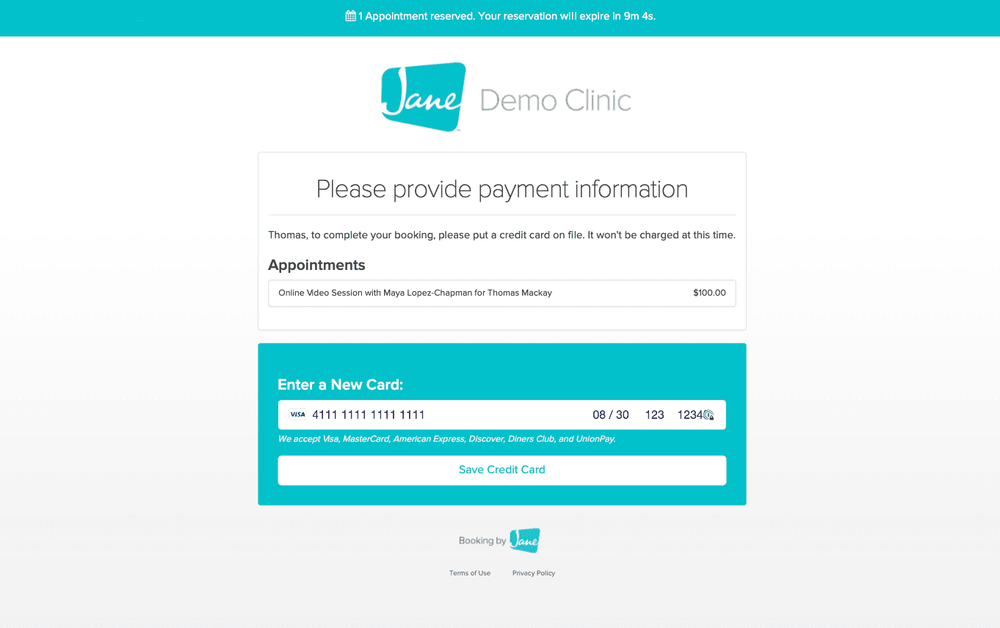
💡 Tip: Once your clinic is open, you'll need a reliable way to collect payment from patients. This is worth thinking through early. And not just how you’ll take payments, but how those payments connect to your invoicing and records. Jane Payments is built right into Jane, so every transaction automatically syncs with an invoice. No manual reconciliation, no gaps in your records.
Step 6: Permits and municipal licensing
For Canadian health and wellness providers, provincial registration covers the majority of requirements highlighted above. However, for some practices, federal and municipal permits will be needed as well.
Healthcare occupancy often carries additional requirements. A commercial space zoned for "office" use is not automatically approved for healthcare services. Accessibility (wheelchair ramps, accessible washrooms), ventilation, plumbing, treatment room dimensions, and soundproofing standards may apply.
Before you sign a lease, it’s important to remember: your landlord may not know whether the space qualifies, and has no legal obligation to find out on your behalf, so it’s best to contact your municipality directly and confirm the space's occupancy classification.
Specific considerations:
- Is the space zoned for a healthcare practice? This is a question for your municipality.
- Are you selling health products like supplements, or distributing medical devices? These may require federal permits.
💡 Reminder: Plan for an additional four to six weeks (and in some cases up to 12) for permitting. Build this into your opening timeline from the start, not as a contingency plan.
Why open a clinic in Canada?
“My first question to the practitioners I work with is always, ‘Why’, ‘Why are you doing this’,” says Roxanne. Opening a health and wellness business is a wonderful opportunity and a big deal, but it’s also a serious commitment.
Roxanne’s “why” had a lot to do with wanting to make time for her family. “The process can get frustrating. There’s paperwork, hurdles, and even after you start your practice, there're gonna be difficult times,” she says. “And if you don't have a guiding principle, if you don't have a reason, if you don't have your big why, then it's gonna be really easy to throw the towel.”
But Roxanne persisted and is glad she did.
When it comes to opening a clinic in Canada, licensing and registration are pieces of a bigger puzzle. Jane, the company behind this blog, has some further reading on the topic if you’re in the beginning stages of opening or running a business and would love some additional guidance.
▶️ How to Start a Private Practice: A Step-by-Step Guide
▶️ The Complete List of Tax Deductions for Health and Wellness Professionals